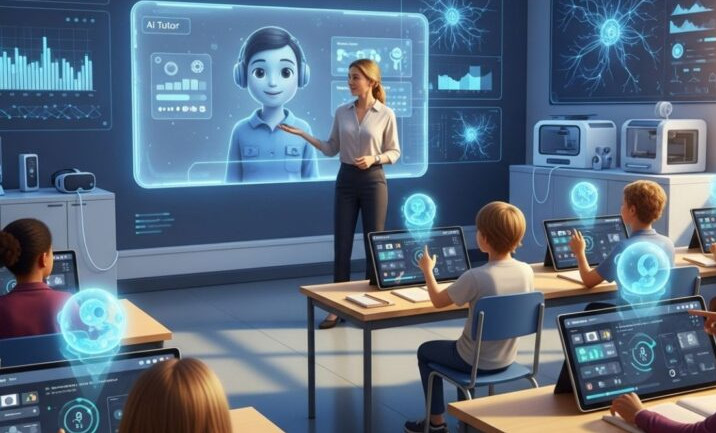






Beyond Textbooks: How AI Tutors Will Personalize Learning Paths by 2026

Picture a classroom of thirty students, one teacher, and a single pace for everyone — even though no two students actually learn at the same speed or in the same way. For decades, this mismatch has left fast learners bored and struggling learners stranded. Now, AI tutors are finally closing that gap, and by 2026 the technology has moved from novelty to genuine classroom infrastructure.
What Makes AI Tutors Different From Traditional Edtech
Older educational software followed rigid, pre-programmed branches: get a question wrong, see the same hint every time. Today's educational AI works more like a patient human tutor. Rather than simply handing over answers, well-designed systems use Socratic questioning to guide students toward their own understanding — an approach modeled directly on classical teaching methods. Khan Academy's Khanmigo, for instance, is built specifically to ask students what they think the first step of a problem is, rather than solving it for them, which helps prevent the tool from becoming a shortcut for cheating.
This shift matters because it reframes AI's role: not a replacement for teachers, but a tireless, one-on-one complement to classroom instruction. For families who cannot afford the $25-plus hourly rate of a private tutor, that distinction can be the difference between a child falling behind and a child catching up.
Real-Time Feedback: Learning That Adjusts as You Go
The core promise of adaptive learning is immediacy. Instead of waiting days for a graded quiz to reveal a misunderstanding, students now get feedback the moment they make a mistake. Some platforms go further, surfacing prerequisite skills a student hasn't yet mastered and offering a quick review before they attempt a harder problem — closing knowledge gaps before they compound.
This isn't theoretical. Khan Academy's own product testing found that giving its AI tutor access to a student's recent performance history — which problems they got right, which they struggled with — measurably improved the odds a student could solve the next problem independently. That metric, often called "next-item correctness," is becoming the industry's real yardstick for whether AI tutoring produces lasting understanding rather than just momentary help.
Coding students see similar benefits: tools that review code line-by-line as it's written, offering suggestions in the moment rather than after a final submission.
Tailored Curricula: One Student, One Path
Perhaps the most transformative shift is curriculum personalization. Instead of a single sequence of lessons for an entire class, AI systems can track exactly where an individual student is strong, where they're shaky, and what interests keep them engaged. Some platforms now let students opt into saving their interests from past conversations — so a student fascinated by basketball might get algebra word problems framed around free-throw percentages instead of generic abstractions.
This is analogous to how a streaming service learns your taste in movies, except the "recommendations" are math skills, reading passages, or science concepts sequenced for maximum comprehension. A middle schooler strong in geometry but weak in fractions doesn't repeat units they've already mastered; the system routes them straight to the gap.
- Diagnostic assessment: AI identifies skill gaps before instruction begins.
- Dynamic sequencing: Lesson order shifts based on demonstrated mastery, not a fixed textbook chapter order.
- Interest-linked examples: Content is reframed around what keeps a specific student motivated.
The Gap Between Access and Actual Impact
It would be misleading to suggest AI tutoring has been a universal success story. Khan Academy has publicly acknowledged that only a small fraction of students with access to Khanmigo use it regularly, prompting a major redesign aimed at making the tool more proactive rather than something students have to remember to open. Educators note a further wrinkle: students can complete several AI tutoring sessions and still perform poorly on tests, because working through a problem with guidance and truly internalizing the material are not the same thing.
There's also a stubborn equity problem. Even the best-designed AI tutor cannot cross the "invisible wall" of unreliable home internet access, which still affects a meaningful share of households with school-age children. Free access to a tool means little if a student can't get online to use it. Genuine personalized learning at scale requires connectivity, teacher training, and student trust — not software alone.
What This Means for Students, Parents, and Teachers
For students, the practical upside is a learning experience that meets them where they are rather than forcing them to keep pace with a classroom average. For parents, it means visibility: many platforms now generate progress summaries that flag exactly which skills need reinforcement at home. For teachers, AI tutors increasingly handle time-consuming prep work — generating quiz questions, drafting rubrics, and summarizing recent student performance — freeing up class time for the human judgment and encouragement that software still can't replicate.
The most credible research organizations, including MIT's Abdul Latif Jameel Poverty Action Lab, are actively running randomized trials to measure whether these tools genuinely improve outcomes, not just engagement — a sign that the field is maturing past hype into rigorous evidence-gathering.
Conclusion
By 2026, AI tutors have moved well beyond the gimmick phase, offering real-time feedback and genuinely adaptive curricula that respond to how each individual student learns. But the technology's success still depends on the systems around it — internet access, teacher buy-in, and thoughtful design that pushes understanding rather than shortcuts. The future of education isn't AI replacing teachers or textbooks; it's AI clearing the obstacles that have always stood between a curious student and the concept they're ready to learn next.
Frequently Asked Questions
AI tutors analyze a student's past performance, mistakes, and pace to identify skill gaps and adjust the sequence of lessons in real time. Instead of following a fixed curriculum, the system routes each student toward the specific concepts they need next, skipping material they've already mastered.
No, AI tutors are largely functioning as complements rather than replacements. They handle repetitive tasks like generating practice questions and giving instant feedback, while teachers focus on mentorship, classroom management, and the human judgment AI still can't replicate.
Well-designed AI tutors use guided, Socratic-style questioning to help students reach answers themselves, rather than simply providing solutions on request. This design choice is meant to build understanding and reduce the risk of students using the tool to bypass learning entirely.
Evidence is mixed but growing. Some randomized studies show measurable gains in math performance, while platforms themselves report improvements in "next-item correctness" — whether a student can solve a similar problem unaided after tutoring — though real-world adoption and consistent use remain challenges.
The main barriers are unreliable internet access in lower-income households, inconsistent student engagement with the tools even when they're available, and the need for teacher training to integrate AI tutoring effectively into classroom instruction rather than treating it as a standalone fix.

No Comments Yet, Write your first comment to start up the conversation