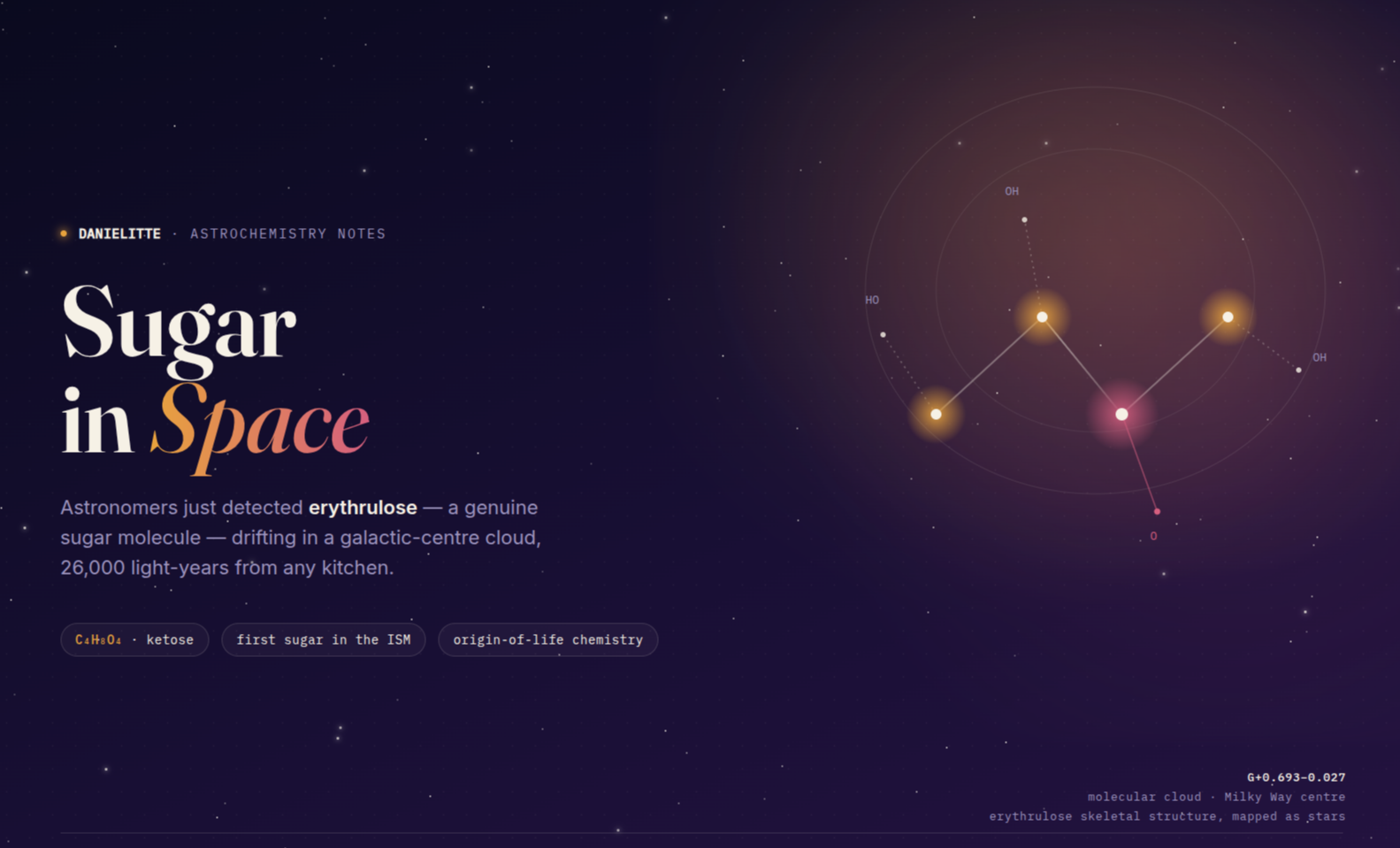






Sugar in Space: Scientists Detect Erythrulose Among the Stars

Somewhere near the center of our galaxy, 26,000 light-years from your kitchen cupboard, floats a cloud of gas and dust laced with a molecule you might recognize from a bottle of self-tanner or a bowl of raspberries. Astronomers have just detected erythrulose, a genuine sugar molecule, drifting in interstellar space for the very first time. It's a discovery that turns a freezing, near-vacuum void into an unlikely chemistry classroom — and it might help explain where the raw ingredients of life came from before Earth even existed.
What Exactly Did Astronomers Find?
Using the Yebes 40-meter and IRAM 30-meter radio telescopes in Spain, a team led by astronomer Izaskun Jiménez-Serra scanned a chemically rich molecular cloud called G+0.693−0.027, located near the Milky Way's galactic center. Every molecule spins and vibrates in a way that produces a unique radio "fingerprint," and the team picked up twelve spectral lines that matched laboratory-measured signatures of erythrulose, a four-carbon sugar. Surprisingly, erythrulose turned out to be at least eight times more abundant than simpler three-carbon sugars, which weren't detected at all. Think of it like walking into a bakery expecting to find plain flour and instead finding only fully mixed cake batter — the "simpler" ingredient was skipped, or reacted away too fast to notice. The result, published in Nature Astronomy, marks the first direct detection of any true sugar in the interstellar medium.
What Is Erythrulose, Structurally Speaking?
To understand why this matters, it helps to know what erythrulose actually is. Chemically, it's a four-carbon ketose — a carbohydrate built around a chain of carbon atoms, one of which carries a ketone functional group (a carbon double-bonded to oxygen), while the rest carry hydroxyl groups (–OH). This same combination of hydroxyl and carbonyl groups is what defines every carbohydrate, from the glucose in your bloodstream to the fructose in fruit. On Earth, erythrulose occurs naturally in raspberries and is used commercially in sunless tanning lotions, where it reacts with proteins in dead skin cells to create a golden-brown color. In space, that same functional group arrangement formed under conditions about as far from a kitchen as you can get: temperatures near absolute zero and pressures far lower than Earth's atmosphere.
How Do Complex Molecules Form in the Freezing Vacuum of Space?
Molecular clouds aren't empty — they contain countless microscopic dust grains, each coated in a thin layer of ice made of water, carbon monoxide, and other simple molecules. These icy grains act like a chemistry lab freezer: at such low temperatures, atoms and small molecules that drift onto the ice surface get "stuck" long enough to slowly bump into each other and react, rather than instantly flying apart. According to the study's models, erythrulose likely formed on these grains from simpler two-carbon precursors, such as glycolaldehyde and ethylene glycol, gradually assembling into a four-carbon sugar. This challenges the standard assumption in astrochemistry that molecules grow one carbon atom at a time — instead, larger fragments may combine directly, like snapping together two two-piece LEGO bricks rather than adding one stud at a time.
Why This Matters for the Origin of Life
Sugars aren't just sweet — they're structural. Ribose, a close chemical cousin of erythrulose, forms the backbone of RNA, the molecule many scientists believe preceded DNA in early life. A central puzzle in origin-of-life research has always been that lab experiments simulating early Earth conditions struggle to produce sugars in meaningful concentrations. If sugars like erythrulose can form in space and later get incorporated into comets and asteroids, they could have been delivered to the early Earth ready-made — no lucky lightning strike required. Researchers estimate that somewhere between roughly 0.5 and 50 million metric tons of such material could have reached young Earth, arguably supplementing whatever prebiotic chemistry was happening locally. Scientists have already found related sugars in samples from the asteroid Bennu and in meteorites like Orgueil, adding weight to the idea that space rocks may have seeded Earth's early chemistry.
The Bigger Chemistry Lesson
This discovery is a great real-world example for anyone learning organic chemistry basics. It shows how identifying functional groups — hydroxyls, ketones, aldehydes — lets chemists classify a molecule's family and predict its behavior, whether it's in a lab flask or a light-year-wide gas cloud. It shows how carbohydrates are defined by a repeating structural logic, not by taste. And it shows that complex organic chemistry doesn't require Earth-like conditions at all — just time, cold surfaces, and simple starting ingredients. For further reading on the original findings, see the paper in Nature Astronomy, coverage from Phys.org, and analysis from Chemical & Engineering News.
Conclusion
Finding a sugar molecule drifting between the stars reframes how we think about life's ingredients: they may not have needed a planet at all to get their start. Studying organic chemistry — functional groups, molecular structure, reaction pathways — gives us the tools to read these cosmic clues and trace a plausible path from simple interstellar ices to the complex biochemistry of living cells. The universe, it turns out, may have been baking the basic building blocks of life long before Earth was even a rocky ember around a young sun.
Frequently Asked Questions
Erythrulose is a four-carbon sugar molecule normally found in raspberries and sunless tanning products. Its detection in the molecular cloud G+0.693−0.027 marks the first time a true sugar has been directly identified in interstellar space, suggesting sugars can form before stars and planets even exist.
Astronomers use radio telescopes to capture the unique rotational and vibrational "fingerprint" each molecule emits as radio waves. By matching these signals to laboratory spectra of known compounds, researchers confirmed erythrulose's presence in the cloud.
It's a strong possibility rather than a proven fact. Researchers estimate that comets and asteroids carrying molecules like erythrulose could have delivered a substantial amount of prebiotic sugar to early Earth, supplementing whatever chemistry happened locally.
Sugars form the structural backbone of nucleic acids — ribose is part of RNA and deoxyribose is part of DNA. Finding sugar-forming chemistry in space raises the possibility that key RNA-related molecules could also form there.
Microscopic ice-coated dust particles in molecular clouds give simple molecules a cold surface to land on and linger long enough to react with neighbors. Over millions of years, this lets small molecules gradually combine into larger, more complex ones like erythrulose.
Browse Resources
free
Sugar in Space: Free Downloadable Guide to Erythrulose & the Origin of Life (PDF)
A free danielitte reference explaining the first detection of a sugar molecule (erythrulose) in interstellar space — covering its chemical structure, how it forms on icy dust grains, and what it means for the origin of life. Includes sources and an FAQ.
Login to Download

No Comments Yet, Write your first comment to start up the conversation