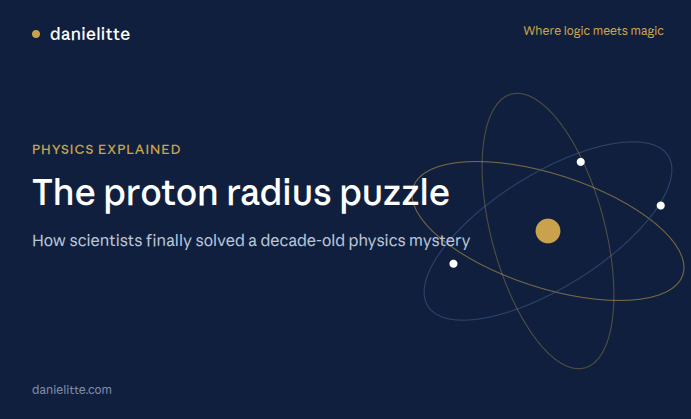



The Proton Radius Puzzle: How a Decade-Old Physics Mystery Was Solved

For over a decade, one of the smallest measurements in physics caused one of the biggest headaches in science. A single number — the radius of the proton, roughly a trillionth of a millimeter — refused to agree with itself depending on how it was measured. In 2026, a new generation of ultra-precise laboratory experiments finally closed the case, and the story behind it is a masterclass in how physics actually makes progress.
What Is the Proton Radius, Anyway?
Every atom has a nucleus, and the simplest nucleus of all — a single proton — sits at the center of hydrogen. Although protons are often drawn as tiny solid balls, they are actually clouds of quarks and gluons bound by the strong force, and their "edge" is fuzzy. Physicists define the proton radius as the distance over which its electric charge is spread out, similar to describing the size of a cloud by how far its water droplets extend before thinning into clear sky. This value matters because it appears directly in the equations of quantum electrodynamics, the theory that governs how charged particles like electrons interact with electric and magnetic fields. Get the proton's size wrong, and every energy-level calculation for hydrogen — the simplest atom in the universe — becomes slightly wrong too.
How Do You Even Measure Something That Small?
Scientists use two main techniques. The first is electron scattering, where a beam of electrons is fired at a target of protons and physicists study how the electrons bounce off, much like determining the shape of a rock at the bottom of a murky pond by watching the ripples from thrown pebbles. The second is atomic spectroscopy, which measures the exact energy of light absorbed or emitted as an electron jumps between orbits inside a hydrogen atom. Because the proton's size ever so slightly changes those energy levels — an effect similar to how a slightly larger sun would subtly shift a planet's orbit — physicists can work backward from the light's precise color (or frequency) to calculate the proton's radius. Before 2010, both methods largely agreed on a value around 0.877 femtometers.
The 2010 Shockwave: Enter the Muon
In 2010, a research team tried something different: they built "muonic hydrogen" by replacing the atom's electron with a muon, a heavier cousin of the electron that is about 200 times more massive. Because a muon is heavier, quantum mechanics dictates it must orbit far closer to the proton than an electron does — imagine swapping a satellite in a distant orbit for one skimming just above the atmosphere. That closeness makes muonic hydrogen exquisitely sensitive to the proton's actual size. The result stunned physicists: a radius nearly 4% smaller than the accepted value. This discrepancy became known as the proton radius puzzle, and it was large enough to be a real crisis rather than a rounding error.
Why This Small Gap Mattered So Much
A 4% mismatch might sound trivial, but in precision physics it was seismic. Quantum electrodynamics is one of the most rigorously tested theories humans have ever built, verified to better than one part in a billion in some experiments. If muonic hydrogen was telling the truth and regular hydrogen measurements were correct too, something fundamental might be missing from physics — perhaps muons interact with protons through a subtly different force than electrons do, hinting at entirely new particles or interactions beyond the Standard Model. Alternatively, one of the measurement techniques could simply contain an overlooked systematic error. For years, nobody could say for certain which explanation was correct, and both possibilities kept theorists and experimentalists busy chasing the answer.
The 2026 Resolution: Precision Wins the Day
The turning point came through steadily improving spectroscopy of ordinary electronic hydrogen. Teams — including a widely reported effort at Colorado State University — refined tabletop laser spectroscopy to unprecedented accuracy, using ultraviolet lasers to drive hydrogen's electrons between energy states and reading off the resulting frequencies with extraordinary precision. Their result placed the proton's radius at approximately 0.84 femtometers, matching the smaller muonic hydrogen value almost exactly. Around the same time, an independent measurement pushed precision even further, and both were reinforced by updated lattice QCD calculations — first-principles theoretical predictions from quark-level physics — that also favored the smaller radius. With electron-based spectroscopy, muon-based spectroscopy, and theory finally converging, the Particle Data Group could report a consensus figure near 0.841 femtometers, effectively closing a debate that had run for a decade and a half.
What Actually Went Wrong Originally
In hindsight, the puzzle wasn't evidence of new physics — it was a lesson in how difficult ultra-precise measurement really is. Earlier electron-scattering experiments and early spectroscopy carried small, previously underappreciated systematic uncertainties, similar to a ruler that is ever so slightly miscalibrated but still consistent with itself across repeated readings. As detector technology, laser stability, and statistical techniques improved, those hidden errors shrank until the "big" 4% gap dissolved. Far from being a failure, this is exactly how physics is supposed to work: an anomaly triggers intense scrutiny, competing techniques are refined independently, and nature ultimately arbitrates.
The proton radius puzzle is a reminder that even the best-established theories deserve to be tested down to the finest decimal place, because that is where new physics — or, just as valuably, deeper confidence in existing physics — actually hides. Precision measurement isn't a footnote to discovery; for fifteen years, it was the whole story. Students encountering atomic structure, spectroscopy, and quantum electrodynamics for the first time are inheriting a version of physics that was quietly, rigorously stress-tested at the smallest scales imaginable — and came out stronger for it.
Frequently Asked Questions
It was a mismatch between two measurements of the proton's size: one using regular hydrogen atoms and one using special "muonic hydrogen" atoms. The muonic measurement gave a radius about 4% smaller, and scientists spent over a decade figuring out why.
The discrepancy was eventually traced to small systematic errors in earlier measurement techniques rather than new physics, and improved experiments in the mid-2020s confirmed the smaller radius was correct all along.
Muons are about 200 times heavier than electrons, so in muonic hydrogen they orbit much closer to the proton. This closeness makes the measurement far more sensitive to the proton's actual size, which is why it first revealed the discrepancy.
New ultra-precise laser spectroscopy experiments on ordinary hydrogen, combined with improved theoretical calculations from quantum chromodynamics, both converged on a smaller proton radius near 0.84 femtometers, matching the muonic hydrogen result and resolving the disagreement.
Quantum electrodynamics (QED) provides the equations linking an atom's energy levels to the size of its nucleus, but the proton's actual radius comes from experimental measurement and from quantum chromodynamics calculations of its internal quark structure.
The proton radius is a key input for testing QED's predictions about atomic energy levels with extreme precision. Getting it right (or wrong) can reveal whether our fundamental theories of matter are complete or missing something important.
Browse Resources
free
The Proton Radius Puzzle — Student Worksheet & Answer Key
A free, printable worksheet from danielitte.com that helps students explore the proton radius puzzle — a real physics mystery spanning atomic structure, spectroscopy, and quantum electrodynamics. Includes vocabulary matching, short-answer and critical-thinking questions, a data-based numeracy section, and a full teacher answer key.
Login to Download

No Comments Yet, Write your first comment to start up the conversation